Sunday, December 30, 2012

Saturday, February 19, 2011
Who Is A Grandchild and Who is a Cousin?

The following is an explanation regarding the Tiyospaye and how we refer to our relatives. It’s an excerpt from a paper I wrote on “Lakota Social Change” for a class I took at the University of Nebraska.
A Lakota’s relatives are classified according to the generation they belong to and what sex they are. There is no regard to whether they are related through the father’s or mother’s line. The kinship term used in the traditional culture determined one’s behavior toward the person. Parents, grandparents and brothers and sisters were treated with love and respect. One, however showed more restraint around the persons referred to as aunt and uncle.
For example, one would use the same term Ina for their mother and their mother’s sister; Ate would refer to both their father and their father’s brother. Your mother’s brother would be called Lekshi and your father’s sister would be Tonwin – both of these terms are roughly the equivalent of aunt and uncle in American kinship terminology. The terms for sister and brother would be used for siblings and the children of those they called mother and father (i.e. parallel cousins—the children of your maternal aunts and paternal uncles). There were, however different terms for brother and sister depending upon if they were older or younger and what gender the person was, who was speaking. The terms for cousin also depended upon the gender of the person talking.
The way in which Lakota refer to their relatives is often confusing for Non-Indians – for example a Lakota may call someone ‘aunt’ who the Non-Indian would refer to as ‘cousin’. The rule normally is that all of the cousins in the parent’s generation would be aunts and uncles no matter how distant the relationship was. All of the individuals in the generation who are recognized as parents by both the mother and father are called grandparent. There is no term for ‘great aunt’ or ‘great uncle’. (end of excerpt)….
We use a story as an example of how we are sometimes faced with a cultural clash
 when dealing with relationship and the larger society. My oldest son was in a biology class were they were learning about genealogy and was supposed to create a family tree. He listed his father’s aunt as his grandmother and the teacher tried to correct his paper by telling him that she was not his grandmother but his great-aunt. My son was furious with the teacher and told him “I don’t care what you say she is my grandmother!” We experience this constant attempt on the part of Non-Indians to correct us on who is what according to the manner in which Euro-Americans refer to relatives.
I find the idea of one of the grandchild of my first cousins who I refer to as a sister being my fourth cousin and not a grandchild severely limits the relationship and as a result puts barriers between me and this grandchild.
Saturday, February 5, 2011
Sovereignty: How Should We View It or Should It Matter?

2. the right or power to enforce rules or give orders
3. the power to act on behalf of somebody else
4. independence with the freedom to make decisions on how to live
5. the freedom from dependence on or control by another person,
6. existing as moral agents to decide right from wrong


Saturday, January 29, 2011
The Lakota Concept of Peace

Wolakota a very old Lakota Term used to describe Rules & Concepts of Behavior established in the distant past to address problems dealing with Internal Fighting.
Wolakota means to act and behave with ultimate respect, harmony, peace and friendship.

The ultimate symbol of Wolakota is the pipe and the foundation of Lakota society is Waohola (Respect).
Monday, January 17, 2011
How Do We Learn To Understand the World


Although as a child she lived through the most difficult time for the Lakota she never lost sight of who she was and how she saw the world. She was a kind and gentle individual who was a true philosopher, in the truest sense of the definition. She explained how I should think about life, how we were connected to the things, people, and the land, around us. She didn't just say these are the beliefs, the values, the traditions, why and how we exist. She helped me understand how I fit into this world and did it in a subtle and wise manner by using the old manner of socializing a Lakota child. She used stories, examples, and long talks about what it meant to be a child who represented our family.
We were taught how to share, to show respect to the older members of our family, to try not to embarrass her in front of our In-Laws, to be quite when people came to visit or when we went with her. We could not run around, be loud, fight, or ask for something to eat. I don't know why she took us when she went to visit. It was more likely she wanted us to either learn proper behavior or she didn't want to leave us to get into trouble while she was away. I remember she would feed us before we left so that "we wouldn't act hungry" but when we arrived and they offered us food we were never to turn our nose up at anything and gladly eat what ever was offered. Some times what we ate was not appetizing but we were expected to finish even when we were so full we would almost burst. This lesson has served me in important times when I had to eat many un-pleasant things as an adult.
One of her most important teachings was not to be stingy. To be generous is one of the foundations of Lakota society. It was taught very early in a child's life and when children showed any form of being generous they were praised, if they showed the opposite they were told that it was very wrong to behave in that manner. I learned this lesson very early. My mother told a story about a time when I was three years old. She said my Uncle Paul brought me a bag of candy and as a good Lakota child I went around and passed the candy out. When I got to him I looked in the bad and there was only one left. I looked at him looked at the candy and then took a bite of it and then gave the rest to him. Of course all the adults gave theirs back so that I could enjoy my treats. This is an example of how early these teachings were instilled in children.
I was blessed with this loving woman who I spent much of my earliest childhood. Each night she told me stories that taught behavior that was expected. She answered all of my childish questions and did so with stories so I would not forget the teachings. Her outlook on life was modeled by her behavior. She wore her hair in braids, sewed dark colored dresses, wore thick stockings and always wore a black scarf when she went anywhere. She baked bread and cooked beans on Monday and as a result all of her grandchildren were very popular because there was always enough to feed all of our friends. My life is rich because of her and I still her voice when I face a dilemma that would bring her shame if I choose the wrong way.
Sunday, January 16, 2011
A Meeting of the Generations


Friday, December 31, 2010
So What Is This Blog About?

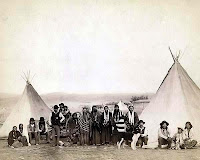
- Traditional Lakota Childcare practices.
- Traditional Stories that taught morals to children and instilled proper social behavior,
- Tribal Government in the Past, Present and future,
- What it means to be a Lakota Women and how this has strengthened our people and helped us to survive,
- How we survived using innovative techniques and systems that were meant to control us and defeat us...
Thursday, December 30, 2010
I'm Back

Wednesday, July 22, 2009
Sunday, July 5, 2009
Poem About the Statue of Liberty
Ms Liberty
She stands with arms open wide.
Proclaiming liberty & justice
for all who crawl onto these shores.
Ironically I’ve always thought
her back is turned away from us.
Has she ever turned and smiled
allowing us to be encompassed
in her strong arms.
She is a cold iron statue green with age.
She stands at our eastern door
blessing all thieves who enter
A sacred thing brought
to these shores by strangers.
To proclaim freedom and liberty to the world
the rights so clearly denied to the caretakers.
From sea to shining sea blood sacrifice
is laid at her alter - Land of Liberty, Land of Lies
The bounty of each acre has lined their pockets
as they raped each inch.
Killing all life that stood in the way of progress
While there goddess looked the other way.
French woman, french whore
set up as some goddess to rule this land
Who gave you the land to give to a people who
only pillage and plunder.
You've taken from the children of the great
Corn Mother and White Buffalo Woman.
Turn and look at the destruction your-open door policy has
wrecked on this beautiful land.
Mary Lee Johns
Lakota
This is a poem I wrote about the people who Ms. Liberty does not embrase.
Poverty Clutching At You
(In memory of all my uncles who let alcohol rob them of life)
Poverty clutching at you
pulling you into despair
looking at the world
through eyes of hopelessness
Wishing for the old times
knowing dreams
have flown like old torn ribbons
into the icy northern winds
You can still remember
tender childhood moments
from a storehouse
of old memories
Shutting them out
you cringe inside
knowing happiness
is a thing of the past
Your left with the
cold breath of reality
breathing down on you
Sitting you look out
at the streets of mud
your spirit screams
with silent sorrow
While poverty
clutches at your soul
Mary Lee Johns
Lakota
Shadow Land
They are
the grey ghosts
of urban streets and allies
spiritually starved
desperate
passing by unseen
avoiding eyes
hiding within
cement tombs
clutching sweaty
brown paper bags
filled with sweet
poisoned pleasure
shamed and sickened
by an insatiable need
bleary eyes
heads pounding
like drums
pain screaming
like pow-wow singers
guts twisting
like snakes from hell
the past only
a blur of forgotten dreams
today’s battle
is for one last bit of sanity
a world of nightmares
and shadows
an end to a long
endless spiral of pain
mary lee johns
Lakota
The Walking Dead
walking through an indian bar
is like walking through a cemetery
everyone is in some stage of death
Saturday, June 27, 2009
Poem about the making of a Lakota Dessert
When I was a small child one of the activities the grandchildren who spent their summers with our grandmother at the Poor Buffalo ranch was gathering traditional food. This was then stored for the winter. I attempted to capture this activity in the following poem. I hope you enjoy it.
Wojapi
I
Just like everything else in our world
there are two kinds of Wojapi the
traditional and the modern kind
I’ve made both.
Because I now live in today’s world
of computers, E-mail, FAX machines
and fast cars,
I can’t remember the last time
I’ve even made the modern kind.
I do remember that several years ago
I taught a niece how to make it over
the telephone
it’s real easy all it takes is a can of
blueberry pie filling (my family’s favorite flavor)
some water and cornstarch.
But to make the traditional wojapi
takes planning especially if you want to fix it
when the snow is blowing at sixty miles an hour
and its forty below and you want to prove
how really traditional you are to some
white sociologist who is sitting at your table
all starry eyed looking beyond your head to 1868
trying real hard to experience the “Real Lakota Way”.
You can’t hardly grab a can of blueberry pie filling
and prove your a real Indian by whipping up
a batch of modern wojapi
No way - he won’t fall for the can.
II
To do it right you would have
had to go out in the middle
of a hot sweaty August day
among the flies, grasshoppers
and rattle snakes
and find a black cherry tree.
You would have had
to spend hours straining
your muscles reaching up
and picking the little black berries
that stain your hands and teeth for
days afterwards.
III
Now if you were really going to do it right
so you could recount the tail to your
starry eyed guest you would have taken
along the proper equipment. An old lard pail
(the two quart variety) hanging on a piece of
string to allow you to use both hands.
If you were a good fast strong Lakota women,
in a very short period of time, you would have
picked several cans but if you were like me
it would take you hours.
Hours of sweat running down the pits of your
arms, down your torso, down the backs of
your legs and all across your forehead while
being bit by every blood sucking insect around
for miles.
IV
Having finished the first phase of making
traditional wojapi you would now be ready
to move on to the second phase.
This, of course-- should have been completed
under a shade assembled next to your house
because no self respecting traditional Lakota
home went without an old fashion traditional
shade where all activity was conducted through
the hot summer months -from cooking to sleeping.
The shade was built using young cottonwood trees,
with the first Y’s in their trunks, these held up
cross logs tied tightly together with more branches
added to make a loosely woven roof. On top of all
these strong limbs, willow branches were added
with their leaves in full bloom.
Babies were hung in their cradle boards and
drifted off to sleep to the rustling of those leaves
and all manner of gossip being discussed
to pass away the hours.
V
The tools we used had been handed down
from great, great grandmothers two sets of
beautifully hand-crafted mortar and pestle
made from Black Hills pink quartz. In the
center was a small indent about the size of
a small fist. This is where you would place
the berries and proceed to smash them
seeds and all making a beautiful purple paste.
If you measured just right each handful of
berries smashed would make a small flat patty
when rolled and patted out.
You would then place all of these little patties
on a flat card board and put them out in the
hot sun to dry. They would eventually become
flat little hard disks – easily stored for the winter.
VI
This is what you would bring out to impress
your sociologist guestthat your
“A Real Indian – of the Traditional Variety”
and make the real wojapi.
But if your like all the rest of us who live on
the fast track. You’ll call for a pizza to be
delivered and still make him believe your
traditional while checking your messages
on your cellular phone.
Mary Lee Johns
Thursday, June 25, 2009
Thoughts on Victory Day
(Little Big Horn - June 25, 1876)
I wrote this several years ago and thought it would be appropriate to post it on this day that the Lakota call Victory Day. It's Victory Day because if we had not been successful there are many of us who would not be here. This includes my family - my great grandmother was a six year old little girl who was watching this battle take place. So for the fact that we are here it is a day to acknowlede as a day of victory for all of us who would not be here without the courage of our warriors.
To All My Friends & Relatives:
On Tuesday - "Victory Day" - I wanted to write to everyone with something to say but was unable to. Nothing profound seeped into my thoughts and I didn't want to bore you with anything that wasn't. You know how that can be - when you try to force yourself into being creative what you get is old warmed over two day or even year old thinking. And of course being the day of remembering the heroic actions of our unci's and lala's of our past I didn't want to write anything that would'nt give them honor - so I stayed quite and thought of them instead.
But today I do have some things I want to share with you. I was reading an article written by a brand new friend, Charles Peek, professor of English at the University of Nebraska - Karney. He writes about the day Crazy Horse was assassinated. He quotes Touch the Cloud and Nebraska State Poet - Bill Kloefkorn. I want to share these with you and some of my thoughts.
Touch the Cloud - remarks after covering the body of Crazy Horse. (Crazy Horse refused to lie down on a cot he chose to lay on the floor - defying the U.S. Government even as he was dying from the fatal wounds inflicted on him by one of his own.)
"That is the lodge of Crazy Horse. Lying where he chose, Crazy Horse showed the rest of us where we are standing."
Bill Kloefkorn, in his poem "Crazy Horse, Final Reflection, Number 7"
It does not matter where his body is,
for there is grass;
but where his spirit is,
there it will be good
for all of us to be.
My thoughts are:
We need to realize that our great leader Crazy Horse did show us not only where we are standing but how to stand. He admonished the weak hearts, the fools, the selfish and any of those who did not think of the people to stay in the rear - he only wanted the Brave Hearts to be in the front to meet the full force of the enemy. If we take his statement and use this as a way of living. We can use this as a standard to measure the men and women who want to lead our people. Are they willing to meet the challenge of today's enemies do they have the skills to be in front with our leaders from the past. My great grandfather, Edward Dupris' Indian name was "Eats No Meat" which meant He made sure everyone was taken care of before he took care of himself - he fed everyone first and if there was no meat left then he ate no meat.
Crazy Horse thought always of the people - he showed us how to stand, he showed us how we are standing. When we think of how we are standing would he want us to be beside him facing our greatest enemy or would he tell us to go to the rear.
Bill Kloefkron's poem is a reflection of the fact that the Spirit of Crazy Horse is still here among us - "but where his spirit is, there it will be good for all of us to be." Could we feel good to be where Crazy Horse's spirit is? Would we feel able to stand without feeling shame?
It is good to be a Lakota, it is good to walk this road but while we are walking we need to ask ourselves are we living the true life of a Lakota. When we pray, or when we speak - is it for the good of our people. The Sundance Prayer "Hecel Oyate Kin Nipi Kte" --- "So that the people may live." - should be one of our guiding principals for our work and our commitment to our people. Sitting Bulls statement "Let us put our minds together to see what life we can make for our children" should be another.
The old Lakota war cry "It is a good day to die" can be used as a third principal. We need to live to the fullest so when we do leave to be with our relatives "who live beyond the ridge" will they welcome us knowing that our lives were lived in a manner that we would not regret or leave things un-tended or that we lived a life creating strife, chaos and disruptions - and instead of love we were jealous hearted and made people feel bad.
We need to be a good relative to each other - but most important we need to be good to our children and our grand children. This does not mean that we let them do anything we need to give them good advise so when they become adults they can take their place as strong Lakota - they are who will lead our people in the future and will Crazy Horse want them beside him or to the rear.
Yes Crazy Horse - showed us where we are standing - and it will be good for us to be where his spirit is.
With wishes for your good health and safety this summer.
Your relative and friend,
Mary Lee
Grows in a Day
(Touch the Cloud was my great grandfather, Matthew Poor Buffalo's first cousin)
Monday, June 22, 2009
Poems about the Plains -
I wrote the first one in the 1980's after driving towards Eagle Butte on Hwy 212. This is where you can enjoy the plains in all of its glory. Espically in the spring and there has been a lot of rain and the grasses have grown tall. It looks like a green sea. I love this time of year and want to be there on driving. What is so great is the beauty and the fact that I'm driving towards a meeting with family. What a wonderful sence of freedom can find you.
The second was also written about the same place when I observed the hawks.
Prairie Wind
Wind across the prairie,
blowing, intertwining,
touching everything
in its breath
caressing each blade of grass
as it passes whispering to the flowers
weaving through the branches
moving,
ever moving
flowing over all
creating the beautiful music
for the dancing of the grasses
green and green and green some more
it awakes me to my reality
reminds me of my tomorrows
my thoughts are as the wind
the wind as it is
the substance of the high plains
the strength of the land
my dreams are as the wind
cascading across the night
seeping into my sleep
caressing my thoughts
blowing the past into my memory
whispering about the future
the wind ever moving
ever changing
ice in winter
fire in summer
the wind the music
of the high plains
it makes the land sing
I know the song it is written in my heart
and the heart of my people
hear it softly sing
it whispers
listen to the whisper
it tells of our loved ones
who heard its voice
and have gone on
to walk upon the clouds
hear its mournful cry
crying for our people
it tells of places and
old forgotten names
names that still call out
the existence of our land
wind you are the freedom
that was stolen long ago
you blow it in our faces
whisper it in our dreams
the freedom that is still there
if we want to take it
reach out and grasp it
let our hearts flow
let us join our brothers
as they fly using the wind
to roam across the sky
sky and earth joined together
by the breath of our creator
who blows his blessing upon us
the wind
the beautiful wind
blowing across forever
Mary Lee Johns
Hawk
I fly on Hawk wings caught up
on strong currents across this mighty land.
Looking down my heart grows heavy
I see black ribbons that slash the earth.
I search for my strong black brother he is gone.
Only small herds of his children are left
In prisons of green pastures.
I search for and listen for the howl of my wise
gray brother and hear his song no more.
I search for my red brother and find him huddled
in lost dreams and hovels of loneliness.
The land is lonely for her children
who once fed upon her bosom and bounty.
Only feeble, weak little creatures are left,
their hearts and spirits are strange and sorrowful.
They do not know the language of our songs.
The strong and powerful who knew the songs of our land
have been cast aside driven out by strangers.
My wings grow weary in my search. I find only emptiness
the wind cries for our losses and I am alone.
Friday, June 12, 2009
Lakota Concept of the Family


The family was a closely related group of siblings working together to assure the survival of their children and relatives. In their closeness lay their strength.
"…The Sioux conceived the family as an ever-living yet ever changing entity. As a body of individuals related through descent, it was enduring. Membership was a matter of consanguinity where each person reckoned his affiliation with respect to lineage of grandparents and parents, and with relatives—uncles and aunts, brothers, sisters, and cousins. While the individual might literally choose between belonging to his father's or mother's family, he was nevertheless, a member of both families.." (Hassrick 1964).
"The core of all kinship training" was the correct teaching of behavior and loyalty that was to be shown between brothers and sisters and boy and girl cousins. It was the responsibility of the boys to never "…embarrass his girl relatives but strive to only spare them and make them happy." They were taught, "Your sisters and cousins depend on you, and you must never fail them…" They were also responsible, as men, to train the sons of their female relatives in the ways of becoming warriors. In this way they continued to show honor to the "women of their generation who (they) had been taught to respect, protect, and aid." (Deloria 1988).
Girls were trained to always place their brothers and sisters and cousins above everyone else. A sister was the proper woman who carried her brother's war trophy, won in battle, in victory processions. (Deloria 1988). When a man dressed well—it was an indication that his sisters and female cousins loved him, because they were the ones who made his clothes (White Hat 1993). The women showed their male relatives honor by making them beautifully adorned clothing and making things for their children.
The respect shown between brother and sister was observed by complete face-to-face avoidance after they reached a certain age. They, however were expected to be completely loyal to each other and be prepared to help each other when necessary. Older siblings were responsible for watching their younger brothers and sisters. If a child did something that was considered inappropriate the older one was always admonished in its place. The older children were willingly to be scolded in this manner because of their obligation and love for the younger—knowing that this was the way younger children learned what was considered proper behavior without feeling discouraged. They then observed how their behavior caused problems for their older siblings and would behave accordingly from then on.
I was raised with these same values and behaviors and have incorporated them into the way I raised my children. I remember taking pains to iron my brothers' shirts and pants so they would be perfect. I was the one who ironed because I did the best job. They never left our house without looking like they were loved. They in turn did things that proved on a daily basis how much they cared for their girl relatives. We still flock around and try to outdo each other when they are around us. My sisters are my very dearest friends and their children are cherished and loved as well as their grandchildren. There are people who think the Lakota ways are found only in the past but this is totally incorrect. We still live these ways.
WORKS CITED
Deloria, Ella C. 1988. Waterlily. University of Nebraska Press: Lincoln, London.
Hassrick, Royal B. 1964.The Sioux: Life And Customs Of A Warrior Society University of Oklahoma Press: Norman and London
White Hat, Albert, Sr..1993. Lakota Iyapiun Wowapi Nahan Yawapi (Writing and Reading the Lakota Language), edited by Jael Kampfe. Unpublished Document. Available from author at Sinte Gleska University. Rosebud, SD.
Tuesday, June 9, 2009
Two books on Leadership
Lakota Foundation for Leadership/Management
06 July 2007
Essay
At the beginning of the class my understanding of leadership was basically in regards to what traits and values a good leader should have. I believed that great leaders were “servants” to their people and how a person achieved this altruistic ability was what we would be covering in the class. I also thought the Lakota concepts of Leadership would be the main area of study.
I still believe in the idea of the “servant leader” but my understanding of leadership has significantly expanded. Both books, Leadership Without Easy Answers (1994) by Ronald Heifetz and Real Leadership: Helping People and Organizations Face Their Toughest Challenges (2005) by Dean Williams gave me tremendous insight into what a leader had to do when dealing with difficult situations. The examples they used were excellent. I learned about the idea of adaptive work and how it’s a leader’s responsibility to find ways to help their followers began the process. The idea of real leadership requires getting people to face reality and dealing with tough problems was not new – but many of the ideas on how to accomplish this were. The manner in which both Heifetz and Williams broke the process down into understandable concepts gave me a better understanding of the role of leadership.
Tuesday, June 2, 2009
Granduation
Star Watcher
(In honor of my niece Marcella Gilbert for her college graduation)
I am Star Watcher
daughter of Rides the Wind
Who looks to the stars
to guide my heart
The stars they say
are the holy speech of Tunkasila
If your heart is pure
and your vision is strong
The way of life will come to you
at night in the dream world
Or in the early morning
when you first awake
The possibilities are endless
to those who dare
Swim out into the channels
that flow by
I am Star Watcher
daughter of Rides the Wind
I dare to watch the stars
and listen for the way
I have gone far from home but I know
the path of my returning for
I let the stars guide me
I am Star Watcher
(Lakota translation - Tunkasila : The Creator of all Things)
Honors
(for my niece Marcella Gilbert for
Attaining a Masters of Science in Nutrition)
The old Lakota saying
"the honor of one is the honor of all"
is in the song we sing today
for our daughter
this daughter
who has traveled many, many miles
towards goals that were as high
as the highest mountains
she's traveled
this road with the
same determination of the
old grandmothers
who knew they had to
learn new skills
so we could live
her vision
for her future was sure
it was connected
to the future of our people
she knew
this was the way
she could help
now our
family sings an honor song
for a medicine woman
who knows the secrets
of our food
the secrets
we need so our people and nation
will live
our daughter
has brought many honors
but for me
it’s the love she gives
that warms me
Mary Lee Johns
December 5, 2008
Thursday, May 28, 2009
Historical Statements to Provoke Thought
"Requerimiento" drawn up, in 1537 by the Spanish court and was to be read to the Native populations by priests who accompanied the conquistadors.
"…we ask and require [that] you …acknowledge the Church as the Ruler and Superior of the whole world and the high priest called pope and in his name the King and Queen …our lords and kings of these islands… But if you do not do so, I certify to you that, with the help of God, we shall forcibly enter your country and shall make war against you in all ways and manners that we can, and shall subject you to the yoke and obedience of the Church, and of their Highnesses…"
The English had this to say in 1670:
"They are extraordinarily charitable one to another, one having nothing to spare, but he freely imparts it to his friends, and whatever they get by gaming or any other way, they share one to another, leaving themselves commonly the least amount…"
Powhatan, father of Pocahontas asked in 1609:
"Why will you take by force what you may obtain by love? Why will you destroy us who supply you with food? What can you get by war? …We are unarmed, and willing to give you what you ask, if you come in a friendly manner…"
In 1867 General William T. Sherman stated:
"The more [Indians] we can kill this year the less will have to be killed the next war, for the more I see of these Indians, the more convinced I am that they all have to be killed or be maintained as a species of paupers."
After the Little Big Horn battle Crazy Horse said:
"We had buffalo for food, and their hides for clothing and for our tipis. We preferred hunting to a life of idleness on the reservation, where we were driven against our will. At times we did not get enough to eat, and we were not allowed to leave the reservation to hunt. We preferred our own way of living. We were no expense to the government. All we wanted was peace and to be left alone. Soldiers were sent out in the winter, who destroyed our villages.
The "Long Hair" (Custer) came in the same way. They say we massacred him, but he would have done the same thing to us had we not defended ourselves and fought to the last. Our first impulse was to escape with our women and children, but we were so hemmed in that we had to fight."
Sitting Bull stated the following after he was released from Fort Randall were he was held for 19 months as a prisoner of war:
"White men like to dig in the ground for their food. My people prefer to hunt the buffalo as their fathers did. White men like to stay in one place. My people want to move their tipis here and there to the different hunting grounds. The life of white men is slavery. They are prisoners in towns or farms. The life my people want is a life of freedom. I have seen nothing that a white man has, houses or railways or clothing or food that is good as the right to move in the open country, and live in our own fashion."
On December 20, 1890 (just nine days before the Massacre of Wounded Knee occurred) L. Frank Baum, creator of the "Wizard of Oz" wrote in an editorial in the Aberdeen Saturday Pioneer:
"Why not annihilation? Their glory has fled, their spirit broken, their manhood effaced; better that they should die than live the miserable wretches they are…the whites, by law of conquest, by justice of civilization, are masters of the American continent."
The significant of the date and statement showed that even after we were placed on the reservations and were completely dependent upon the federal government for our very survival some Euro-Americans still wanted us destroyed.
The question I ask today is – Has this changed?
Tuesday, May 26, 2009
A Story About the Relationship of the Lakota Concept of "Kola"
Among my people there is a type of relationship between men called “Kola.” In today's world, it has lost its true meaning. This happened because everyone uses it as you would use the word friend.
The term friend however does not describe the true meaning of the Lakota concept of Kola. A Kola was much more then a friend. It was a term that meant that your Kola was closer to you then your brother. If the opportunity ever arose you would literally lay down your life for your Kola.
The best description that I know of personally was the story of my Uncle Buddy Red Bird and his Kola Norman Red Thunder. This relationship was the personification of the Lakota concept of the Kola.
My uncle was a single man with a big smile who had an infectious laugh that would make you want to join in even though you didn’t know why he was laughing. He was a friendly, outgoing, happy person who made you feel important and always welcome to sit, drink coffee and visit. He was a person who shared what he had from stories to food in the true Lakota way.
He and Red Thunder met while in boot camp during World War II and fought in five battles. To understand how significant five battles were. The men of the 101'st Airborne Division of which the "Band of Brothers" is based on were in three battles.
The story I was told, as I was growing up, was that before each battle Red Thunder would say to my uncle. “Kola, if anything happens to me—I want you to marry my wife and raise my son.” My uncle, of course always would respond by telling him that he would be alright and that they would make it home together. Well Red Thunder didn’t make it; he was killed during the last battle they were in.
Being the true Lakota and living up to the true concept of the Kola. When he returned and was discharged he went to Montana, married Red Thunder’s wife and raised his son.
As a child I loved this story – it was so romantic and yet so very sad. I've thought about my Uncle Buddy over the last two days – I wished I could have spent time with him and asked him questions about his experiences. But like so many of the men who fought in WWII he is now a memory. So during the Memorial Day weekend I try to watch a movie about that war. So this year I watched the entire ten episodes of the "Band of Brothers."
Monday, May 25, 2009
Memorial Day and What it Means to a Lakota Woman
Memorial Day was always an important event in the lives of my family. When I was a little girl I remember the hours and hours the women of my family would spend making flowers out of crape-paper. Even as a small child I was involved. They taught us how to make the simplest flowers. Those simple little flowers were set aside and on the day when the adults left for Greengrass, were most of my family is buried, we kids would walk to the "little boy's grave". The little boy was my mother's older brother who died before she was born. He died of some childhood illness when he was still a baby and was buried on a high hill over looking the Moreau River. We would walk there stand around with our little flowers, sing some songs, say the Lord's Prayer and place our flowers on the little grave, walk back thinking about what would have happened if he would have lived.
As we grew older we then made the more complicated flowers, like the red American beauty roses. A family tradition was for the person who could make the best roses would make four that would be put together and those four would be placed on the grave of my grandfather, Douglas Daniel Dupris whose favorite whiskey was Four Roses. When you consider that the women who dedicated themselves to this activity were opposed to any type of drinking. I no my grandmother never allowed an ounce of alcohol to pass by her lips – but in this tradition she was one of the main supporters. I cannot tell you how it started but it is still something that is being done today by women who still do not drink. Why? Because it's a family tradition that has been passed on for three generations and will continue through the next 10.
Memorial Day is a time when I think about all of those who have gone on and are waiting for me and my generation to join them. I also think about the changes that have taken place from the time I would make flowers from crape-paper to the beautiful silk flowers I send home to be placed on our family's graves that lay together on a hill overlooking the Moureau River Valley. My great, great grandmother Cleans As She Comes lies near her great, great, great, great grandson Benton (Hoakie) In The Woods. This little cemetery is made up of family groups. Each year the adults will tell the younger ones who is who and how they are related. Stories are told and children understand why this activity is important to continue following.
I don't know what will happen tomorrow or next year – but there is no doubt in my mind that when the time comes for me to leave my family and join the others – this is where they will bring me. I will be placed here besides these same people that I love and remember. It gives me great peace to know this. The traditions that have been passed on from one generation to the next will continue because the family will know what to do and how to do this. So each Memorial Day will come and go just as our family does – but our family will continue and this of all things gives me a sense of understanding the idea of continuity. The continuing progress of a family that goes on despite everything that can happen.
There is a Lakota saying – it goes like this. "A Lakota will always belong to a family. They may lose their mother, father, brother, sisters, etc., but they will never lose their family". To understand this you have to understand one of the simplest things about us as a people. The, Lakota unlike many other tribes do not call themselves "the human beings." We refer to ourselves as the "Allies" we are made up of families – the most important thing in the life of a Lakota is their relationship with their family. In fact that was one of the assimilation goals of the federal government was to make a Lakota realize that they could actually view themselves as separate from their families. When this happened it was easier for assimilation to take place. But this has failed just like so many of their plans and on Memorial Day is a time to celebrate the fact that we remain as families.